
Not sure it fits your cell? Book 20 minutes with an engineer who has specified this part before.
Book a callOrdered the wrong size or interface? Here is exactly how sending it back works.
Camozzi Automation GmbH
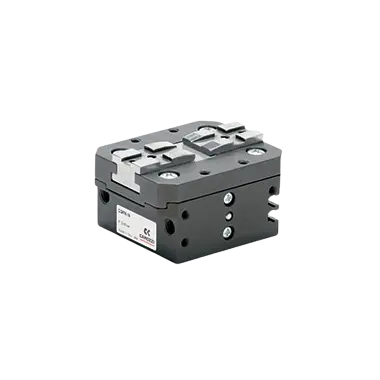
Camozzi CGPM pneumatic parallel gripper with H-guide self-centering, 124 N grip force, 0.02 mm repeatability, 0.12 kg, up to 60°C. Compact design for precision pick and place in assembly.
Camozzi CGPM Parallel Gripper is a pneumatic parallel gripper designed for automated assembly and pick-and-place applications where high precision and compact size are critical.
The CGPM series suits precision pick-and-place tasks, automated machine tending, and assembly line operations where reliable centering and stable gripping are required. The H-guide mechanism ensures consistent alignment, making it optimal for handling small or delicate components.
Choose the Camozzi CGPM Parallel Gripper when requiring a compact and light end effector with repeatable gripping in limited space environments. The H-guide design offers stable linear movement throughout the stroke compared to angular grippers, delivering improved parallel alignment. Pneumatic parallel grippers like the CGPM provide greater holding force than vacuum grippers for rigid or solid parts.
Routine maintenance for the CGPM series involves periodic cleaning and inspection of the H-guide mechanism to maintain repeatability and performance. The gripper easily mounts to standard interfaces and integrates with Camozzi Automation pneumatic systems.
Compared to angular grippers, the CGPM parallel gripper maintains parallel finger motion and tighter repeatability for accurate placement. Unlike vacuum grippers, the CGPM provides mechanical holding for solid parts, making it preferable when high force or resistance to contamination is required.
The Camozzi CGPM is a compact pneumatic parallel gripper suited to high-precision assembly and pick-and-place work on small, solid parts. It differs from vacuum grippers by delivering mechanical gripping force rather than suction, and from angular designs by maintaining parallel finger alignment throughout the stroke.