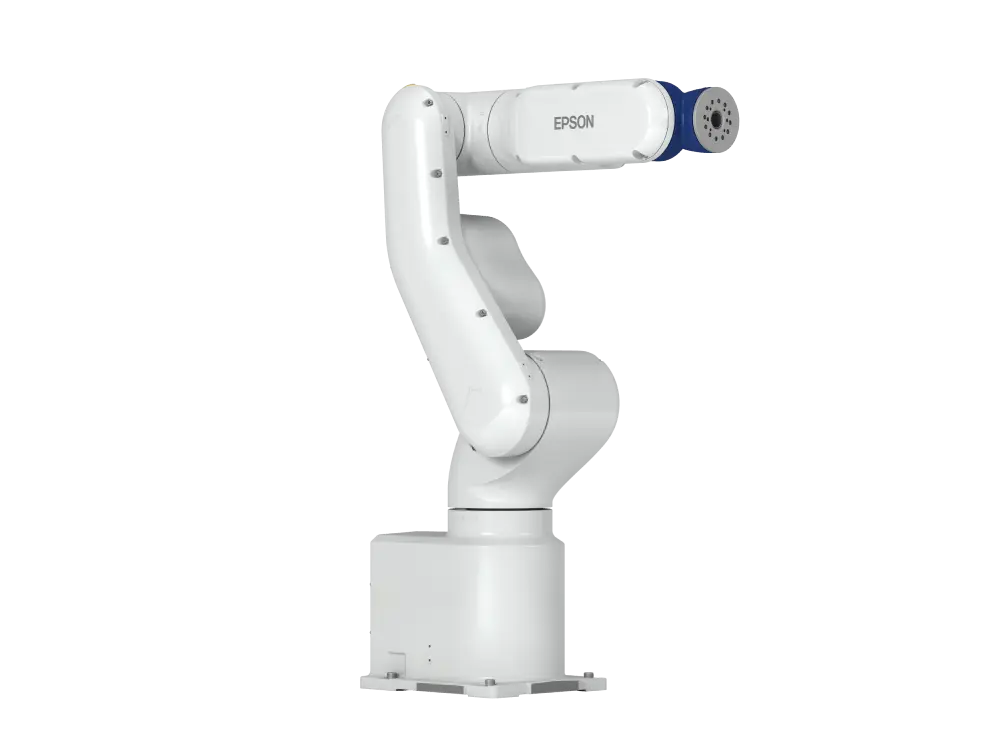
The EPSON VT6-A901S-DC is an industrial articulated six axis robot arm designed for automated assembly, pick-and-place, and inspection tasks where DC-powered mobile robotic arm solutions are needed.
Specifications:
- 6 kg payload capacity
- 920 mm reach
- 40 kg weight
- Direct DC power integration
- IP20 protection rating
Features:
- The EPSON VT6-A901S-DC supports flexible mounting options, including wall, ceiling, and pedestal configurations for optimal facility layout adaptation.
- Built-in controller is accessible with Epson RC+ software, featuring simulation and graphical interface tools for simplified programming.
- Hollow end-of-arm design enables easy cable routing for end effectors and peripheral devices.
- Minimal maintenance requirements streamline deployment and support efficient use of automation cell floor space.
Applications:
- Machine tending
- Quality inspection
- Material handling
- Mobile robotics platforms with DC battery systems
- Collaborative robot alternatives in industrial environments
Technical Terms Explained:
- Six-degree-of-freedom: The robot arm moves in six distinct directions or axes, allowing flexible maneuvering and object handling.
- Repeatability: The ability to return to the same position with high precision, specified at ±0.1 mm for this model.
Comparative Information:
- Direct DC power input avoids the need for DC-to-AC conversion found in AC-powered robot alternatives, making the VT6-A901S-DC ideal for automated guided vehicles (AGVs) and portable applications.
- Competitor models often require separate power conversion hardware, increasing system complexity for mobile installations.
Safety and Compliance:
- IP20 protection rating indicates basic resistance to solid objects and minimal ingress protection. For environments with higher safety requirements, consider additional protective measures.
Frequently Asked Questions:
- What is the EPSON VT6-A901S-DC used for? Commonly used in machine tending, assembly, quality inspection, and material handling, particularly in facilities employing mobile robotic systems.
- Why choose DC power? Direct DC power simplifies integration with AGVs, reduces conversion losses, and enables operation in settings where DC battery infrastructure is standard.